
The way patients find an MSK clinic is changing. We make sure they find you
Patients now ask AI and Google who to see, and both recommend the clinics whose expertise they can find online. We make sure that’s your clinic. We show your team’s experience in the way AI and Google read it, so you’re the clinic at the end of the search and every clinician’s diary stays full. It’s built on 27 years of helping clinics earn trust by educating, never by selling.
This is how a patient finds a clinic now
An example conversation, based on a real one. The patient describes pain under the ball of the foot and asks what it could be; the AI says it is often linked to an irritated nerve between the toes and that a clinician can assess it. The patient asks how it is treated; the AI describes footwear changes, padding or insoles and guided exercise. The patient asks who near them would be good at this; the AI names three clinics, and when asked why, explains that the clinic it put first has a detailed page on the condition written by a named physiotherapist who specialises in foot pain. Coming next: the patient asks the AI to book an appointment, and it offers a time at the clinic.
Soon, AI won’t just name a clinic. It will book the appointment too. If your website isn’t set up for the way AI reads it, you won’t be the clinic it names, or the one it books.
What has changed, and why it matters now
Patients now ask AI who to see
Instead of scrolling through Google, patients describe their problem to an AI tool and ask who they should see. It names two or three clinics. If yours isn't one of them, you don't get a look in.
Your experience only counts if AI can find it
AI tools can only tell patients what they can find, so years of experience that aren’t written down on your website don’t exist as far as AI is concerned.
Your job is safe from AI. Your diary isn't.
Hands-on care is one of the few jobs AI can't do, which makes this a great profession to be in. But it's already a crowded one, with more clinics competing for the same patients, and that could grow as people leave jobs that AI does replace.
The more places patients find you, the more it adds up
Your website, AI answers, Google, emails, social media and your waiting room all work together. The more often patients come across you, the more familiar and trusted you become.
The work takes months to build, and it builds on itself. The sooner you start, the sooner it starts working for you.
From where you stand today to a full diary for your whole team
Four steps, each worth having on its own: find out where you stand, know exactly what to fix, become the clinic AI and Google recommend, and share your expertise with your local community. Then the results come back and show you what to do next.
What each step does for you
These are our four services, and what each one does for you. Most clinics start with step 1: it’s free.
Find out where you stand. It’s free.
Find out, free, whether AI recommends your clinic today. We ask four AI tools the kind of questions your patients ask, built from your own website rather than a generic list. Then we show you your score, how often you were named, what the AI tools actually said, and which clinics they named instead. It takes a minute.
Know exactly what to fix
A practical, prioritised checklist for your website, so that AI and Google can recommend you and more of your visitors book. We go through every page and check whether AI can see your clinicians’ expertise. We also look at your reviews and whether the AI tools can read your site at all, and quote what they actually say about you. You get quick wins you can do yourself, plus a clear list of jobs for whoever looks after your website.
Become the recommended clinic
AI and Google recommend the clinics whose expertise they can see, so depth matters. We research and write the condition, treatment, service and blog pages that show what your team knows. Each page goes out under the name of the clinician who knows that area, so patients get to know your whole team, not just you. Pages are published to the website you already have, or to Co-Kinetic Sites. Then we measure whether the AI tools start recommending you.
Share your expertise with your local community
Being found is only half of it. The Clinic Growth Hub keeps you in touch with new and past patients, with ready-made content and campaigns, an AI assistant to help you run them, and all the tools in one place: email, social scheduling, surveys and more. Tell patients about your new pages, remind past patients you’re there, and fill the gaps in every clinician’s diary.
Start anywhere. The free check, the review, the Clinical Content System and the Clinic Growth Hub each stand on their own, and none of them needs the others. Co-Kinetic Sites is the one thing that is not standalone: it is a bolt-on to the Clinical Content System, for clinics whose website is the problem. If you already have a website, WordPress or anything else, the system publishes to it.
Where we’re heading: marketing you can simply talk to
You trained to treat patients, not to run marketing. So we’re building a marketing partner that does the heavy lifting, and that you can talk to like a person.
It already does two big jobs. It writes the expert content that helps Google and AI tools find and recommend your clinic. And it gives you everything you need to reach your community and build trust: your email list, your social media, surveys and campaigns, all in one place.
Very soon, you’ll simply have a conversation with your Co-Kinetic marketing assistant. It will suggest timely campaigns with the content already written. Tell it what you want to achieve that month or that quarter, in plain English, or choose from its recommendations, and it sets the campaign up, ready to go. The more campaigns you run, the more data it has to work from, and the better its recommendations get. When you’re happy, just tell it to go ahead. Nothing goes out until you’ve OK’d it.
Two ways we help patients find you
- Find out what AI says about your clinic
- A full review of your website, and what to fix first
- A content plan, then clinical content written under your clinicians' names
- A website built for that content, and for AI
- Your own email system, with sequences that run themselves
- Social media scheduling
- Surveys, forms and offers, all in one place
- Your patient list and audiences, with your booking system connected
- Ready-made campaigns, with the emails, posts and offers built in, installed in one click
- A marketing calendar of health awareness days to plan your campaigns around
- Campaigns planned for you through the year, to suit the season and your patients (coming soon)
- Ask for a campaign in plain English, then give it the go-ahead (coming soon)
- Patients who have gone quiet spotted and invited back (coming soon)
- Newly published website content promoted to your email list and social media (coming soon)
- Bookings traced back to the campaign, content or page that brought them (coming soon)
One profession, 27 years, and the same way of working the whole time
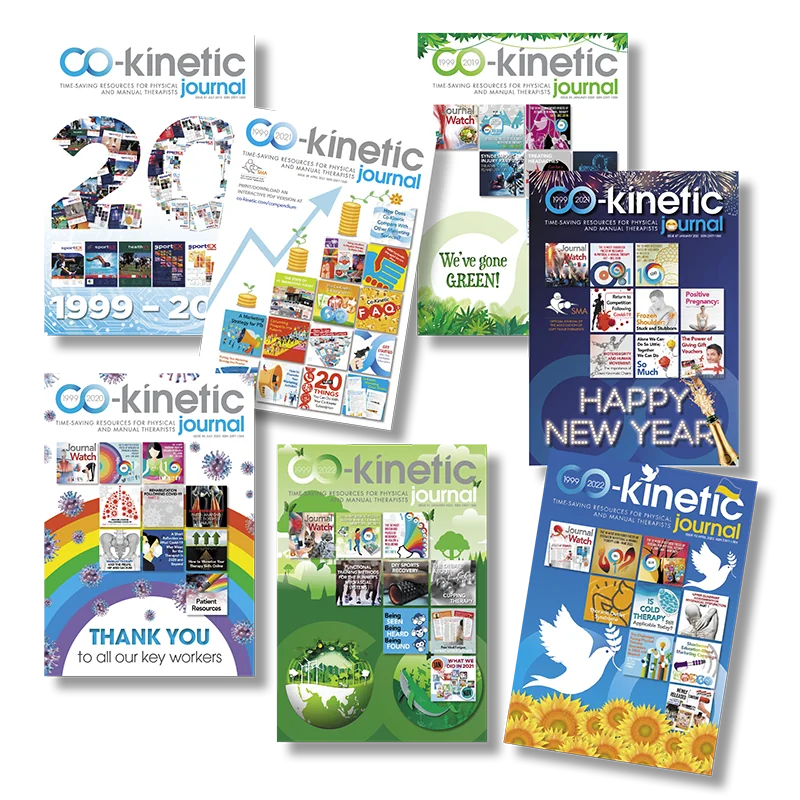
We have never been a marketing agency that found healthcare. We started in July 1999 as a clinical journal for physiotherapists, Sportex Medicine, and shipped patient leaflets with the very first issue. The British Heart Foundation, Diabetes UK and Asthma UK put their names on millions of them. We taught marketing to more than 1,500 therapists before we ever sold them a tool, and when we did build the tools, we built them around educational content, because the people who look after other people's bodies should not have to become salespeople to be found.
Marketing is notoriously hard to prove. Tor Davies, who founded Co-Kinetic, is a former physiotherapist and a sports scientist, and would not ask a clinic to take it on faith. So the system starts from evidence, what the AI tools actually say about your clinic, and it measures whether that changes. Not word of mouth. Data.
Our content has been trusted by leading health and wellbeing organisations

Clinical credibility and marketing expertise, so your content is accurate and it gets found

- Former physiotherapist
- Graduate sport and exercise scientist, Birmingham University
- Medical journalist (Doctor and Hospital Doctor magazines)
- Publisher, Co-Kinetic Journal, 1999 to 2024
- Founder, Co-Kinetic
I am Tor Davies. I trained as a physiotherapist before I became a publisher for physiotherapists, and I have spent 27 years in this one profession, turning research into something a busy clinician could use and patient education into something a clinic could hand out with its name on. Since 2017 that has meant marketing: first the educational campaigns and the platform to send them, and now a system that reads a clinic's website the way an AI does and writes what is missing, under the clinicians' own names.
My father believed you could not make money and keep your integrity. Proving him wrong is still one of the core principles of this company. Everything we build is education first, because that is how trust is earned, and trust is the whole game in healthcare.
Read the whole story on our About page, including who is behind Co-Kinetic today →
What people say about working with us
Education first, trust first. It always has been.
Everything we know about getting clinics found, written up as we learn it. Read the blog →
Latest from the blog
Pulled live from the Coki blog.
Second most recent post
Title and first line, filled by the blog feed.
Third most recent post
Title and first line, filled by the blog feed.
Read the latest from the blog →
What we are learning about how patients find clinics, written up as we learn it.
Got a question about any of this?
The "Ask about this business" panel is on every page. Ask it what the free check looks at, how the system writes under your clinicians' names, what the Clinic Growth Hub replaces, or anything else, and it answers from what Co-Kinetic actually does. No form, no email needed.
How to Get Your Clinic Recommended by AI Search
Sixty minutes with Tor: how AI tools decide which clinics to recommend, what good looks like with real clinic examples, and three things you can do this week with no agency, no budget and no technical skills. Forty minutes of content, then twenty of questions.
Next date to be announced. Register your interest and we’ll let you know as soon as we have a date in the diary.
Register your interest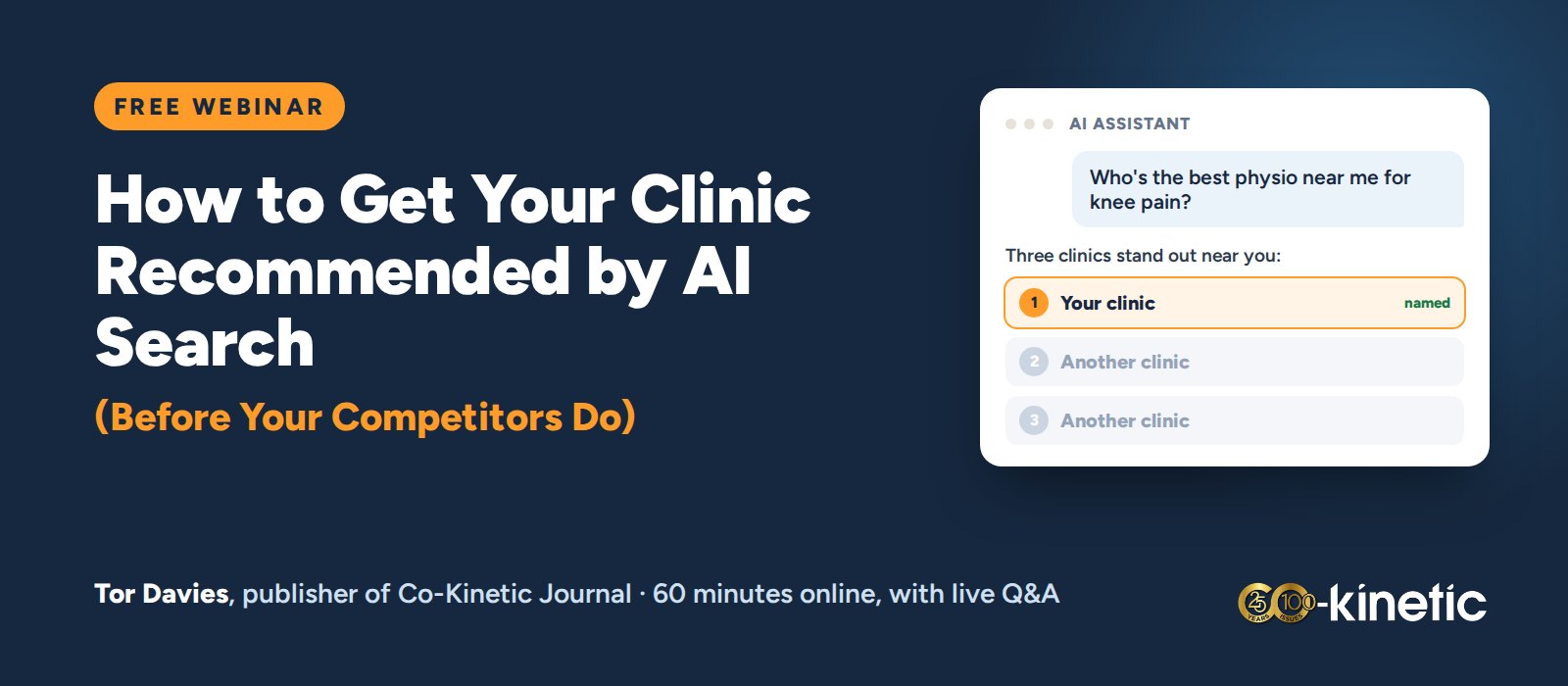
Start with the question that costs nothing to answer

Tor Davies is a former physiotherapist and the founder of Co-Kinetic. She published 100 issues of Co-Kinetic Journal between 1999 and 2024 and has spent 27 years serving physical and manual therapists, always by educating first.
Updated